Reading Your Interlock Compliance Report: What Your PO Sees
Disclaimer
The information in this blog is for general informational purposes only. Information may be dated and may not reflect the most current developments. The materials contained herein are not intended to and should not be relied upon or construed as a legal opinion or legal advice or to address all circumstances that might arise. You should contact your attorney to obtain advice with respect to any particular legal matter. Only your individual attorney can provide assurances that the information contained herein – and your interpretation of it – is applicable or appropriate to your particular situation. Links to any third-party websites herein are provided for your reference and convenience only; RoadGuard Interlock does not recommend or endorse such third party sites or their accuracy or reliability. RoadGuard Interlock expressly disclaims all liability regarding all content, materials, and information, and with respect to actions taken or not taken in reliance on such. The content is provided “as is;” no representations are made that the content is error-free.
If you have an ignition interlock device installed, there is a
document about you that you have probably never seen. Your probation
officer has. Your state DMV monitor has. The court that ordered the
device probably has too. It is called your interlock compliance report,
and it is the single document that decides whether you finish your
program on time, finish it late, or end up back in front of a judge.
Most people only learn what is in it after something goes wrong. The
goal of this guide is to flip that. You will know exactly what the
report contains, who can see it, how often it goes out, and what your
monitoring authority is actually looking for when they open it.
What an
Interlock Compliance Report Actually Is

An interlock compliance report is the full data record your device
captures between calibration appointments, formatted into a document and
sent to whoever is supervising your case. It is not a pass/fail summary.
It is a timestamped event log, with each entry tagged by what happened,
when it happened, and (depending on your device’s options) where it
happened.
Every modern device, including the Dräger Interlock 7000 that
RoadGuard installs, records far more than the breath sample itself. It
records the attempt to take the sample, the result, the time and date,
and a host of other status events. When you read your own report for the
first time, the level of detail tends to surprise people. That is
normal. The detail is the point.
Compliance Report
vs. Calibration Record
These are not the same document, and the difference matters.
A calibration record certifies that your device was serviced,
recalibrated, and verified accurate on a specific date. It is a short
technical document. The compliance report covers the entire reporting
period between service visits and includes every event the device logged
during that window. Your monitoring authority looks at both, but the
compliance report is the one that carries weight when someone decides
whether you are meeting the terms of your program.
What’s on the Report, Line by
Line
Reports vary slightly by provider and device, but the standard
sections are consistent across the industry. Here is what yours
typically contains.
| Report section | What it shows | Why your monitor cares |
|---|---|---|
| Startup attempts | Every time you tried to start the vehicle | Confirms the device was used, not bypassed |
| Test results | Pass, fail, or aborted, with BrAC value | The core compliance signal |
| BrAC readings | Numerical breath alcohol concentration | Patterns reveal more than single values |
| Time and date stamps | Down to the second for each event | Lets monitors spot odd timing |
| GPS location | If GPS is enabled by your jurisdiction | Confirms vehicle was in your authorized area |
| Camera images | If your device has a camera enabled | Verifies the person blowing is the driver |
| Rolling retests | Mid-drive tests with results | Misses or fails here weigh heavily |
| Lockouts | When and why the device locked | Treated as a major event |
| Calibration events | Each scheduled service visit | Confirms you kept appointments |
| Missed calibrations | Service appointments you did not make | Direct violation in most states |
| Tampering events | Disconnects, low-voltage, bypass attempts | Often treated as the most serious flag |
The Dräger 7000 specifically logs each of these categories internally
and uploads the data to RoadGuard’s monitoring system at every
calibration visit, or sooner if your state requires real-time
transmission. If your device has the ignition
interlock camera option, still images are captured at every breath
test and stored as part of the same record.
Who Actually Reads Your
Report
This is where a lot of anxiety comes from, and most of it is
misplaced. The list of people who see your compliance report is shorter
than you think.
Your interlock provider transmits the report to your designated
monitoring authority. That is usually one of the following: your state’s
DMV interlock program office, your probation officer, the court that
ordered the device, or your state’s contracted interlock administrator.
RoadGuard maintains relationships with monitoring
authorities across the country, and the transmission path is set up
at install based on what your court order or DMV restriction
requires.
Here is who does not routinely see your report:
- Police officers generally do not have direct access
without a subpoena or active criminal investigation. - Employers do not see it unless you have given
written consent (some commercial driving roles require this). - The public has no access. Compliance data is not a
public record in any state. - Insurance companies do not receive it directly,
although a violation on your DMV record may eventually become visible if
your state reports it to the licensing database.
If you want to know exactly who is on the distribution list for your
case, ask your provider during your next service visit. They can pull
the routing for your specific account.
How Often the Report Goes
Out
Reporting cadence depends entirely on your state. There is no
national standard, and this is one of the areas where drafts and forums
most often get the answer wrong. The honest version is: it varies, and
you should confirm yours.
In broad strokes, three patterns exist:
- Real-time or near-real-time transmission, where any
violation event triggers an alert within minutes. Used by some stricter
state programs. - Monthly reporting, which is the most common
cadence. Reports go out tied to your calibration cycle. - Quarterly or service-cycle reporting, used in a
smaller number of jurisdictions or for lower-risk program tiers.
You can find your state’s specific reporting rules on your DMV’s
ignition interlock program page or by contacting your monitoring
authority directly. The National
Highway Traffic Safety Administration maintains a useful overview of
how state interlock programs operate, but the specifics for your case
live with your supervising agency.
What Your
Monitoring Authority Is Looking For
Whether the eyes on your report belong to a probation officer, a DMV
reviewer, or a court interlock administrator, the scanning pattern is
similar. Nobody reads every line. They look for signals.
Failed Breath Tests and
BrAC Patterns
A single low failed reading at startup does not automatically mean
trouble. Mouthwash, certain medications, fermented foods, and even a
recent meal can produce a brief positive. A trained reviewer knows this.
What gets attention is a pattern: multiple failures clustered around
evenings, BrAC values that climb across the morning, or failed tests
followed by long gaps in activity.
The clearer your overall record, the more benefit of the doubt a
single anomaly tends to get.
Missed and Failed Rolling
Retests
Rolling retests are the tests the device asks for while you are
driving. A miss happens when you do not provide a sample within the
window the device allows. A fail happens when you do provide a sample
and the BrAC reading is above your state’s threshold.
Both get logged. Failed rolling retests carry more weight than failed
startup tests because you were already on the road. If you have ever
wondered how the timing works, our explainer on how
the ignition interlock rolling retest works walks through the alert
windows and what to do when the device beeps.
Skipped Startup Tests and
Gaps
Long stretches with no test activity raise questions. A monitor
seeing a multi-week gap may suspect that you are driving an unequipped
vehicle, which is its own violation in most states. If your car is
genuinely off the road, document it. Repair invoices, tow receipts, or a
note to your provider create the paper trail that explains the gap.
Tampering and Power Events
Disconnections, sudden voltage drops, and attempted sample-bypass
events all log automatically. The Dräger 7000’s sensors are designed to
detect attempts to feed it air from a source other than a human breath,
and those attempts show up on the report unambiguously.
Innocent events trigger flags too. A dead car battery, a mechanic’s
shop disconnecting the device for repairs, a cold-weather electrical
glitch. The difference between an innocent event and a suspected
tampering attempt is almost always whether you reported it promptly.
Call your provider before the work happens when possible, and keep the
receipts.
What Actually Counts as a
Violation
This is the question with the most varied answer in the entire
interlock world. Every state writes its own definition. Some examples of
how the line gets drawn:
- Stricter states treat any failed test, missed
retest, or tampering event as a violation that resets your compliance
clock or extends your program. - Mid-tier states focus on BrAC thresholds (often
0.025 or 0.04), missed rolling retests, and confirmed tampering. A
single low failed startup with a clean follow-up may not count. - More lenient states look primarily at the overall
pattern across a defined window, with violations triggered only at
certain accumulated event counts.
Your specific definitions live in your court order, your DMV
restriction notice, or your probation conditions. If you do not have a
clear written version of what counts as a violation in your case, that
is the first document to request. RoadGuard’s lockout
and violation support page is also a good first stop when something
has already triggered.
How to Request Your Own
Report
You are entitled to see what your monitor sees. The process is
straightforward.
Call your provider and ask for a copy of your most recent compliance
report. For RoadGuard customers, that means a quick call to your service
center or to the main line at 1-833-545-0368. Most providers can email a
copy or print one for you at your next calibration visit.
Read it before your next check-in. If you see an event code you do
not recognize, ask your provider to translate it in plain English.
Knowing what is in the document before your PO opens it puts you in the
position of answering questions instead of being surprised by them.
If you live with concerns about the privacy
of interlock camera footage, that explainer covers who has rights to
the images and under what circumstances.
How to Keep Your
Report Clean Until Removal
The boring strategy works. It really does.
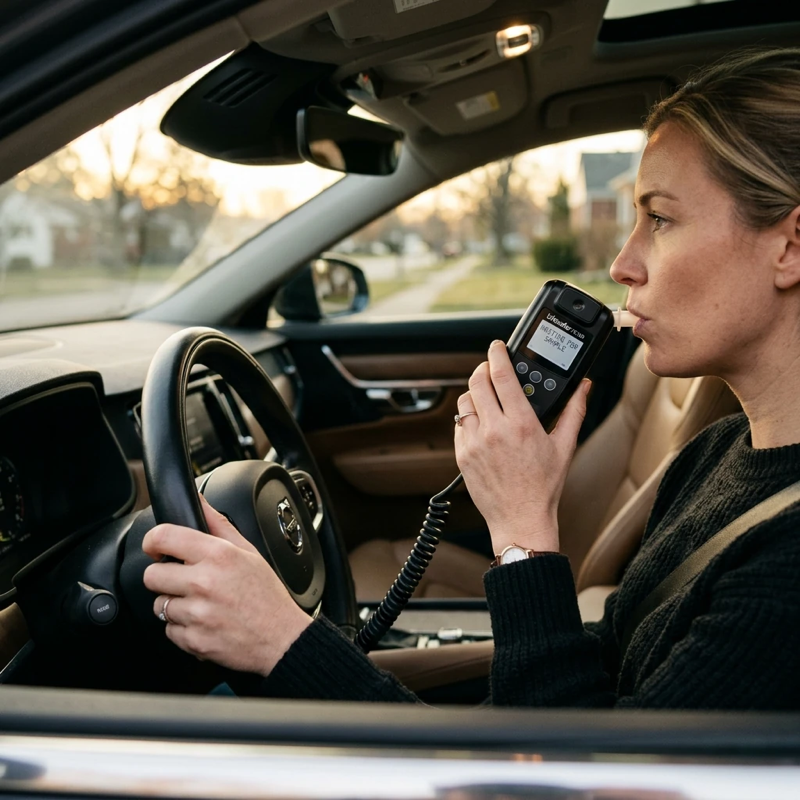
Show up for every calibration appointment on time. Rinse your mouth
with water before every breath test. Pull over safely the moment your
device asks for a rolling retest. Keep a personal log of anything
unusual: a dead battery, a vehicle repair, a medical procedure, a
medication change. When something flags later, that log turns a
suspicious event into an explainable one.
If you are unsure how a routine situation will read on the report,
ask before it happens. It is much easier to pre-clear a planned mechanic
visit than to explain a tampering flag after the fact.
Frequently Asked Questions
What does my PO
actually see on the report?
Your PO sees a chronological log of every event your device recorded:
startup attempts, test results, BrAC readings, time and date stamps,
missed and failed rolling retests, lockouts, tampering or power events,
and calibration history. If your device has GPS or camera enabled, those
are included. The format is designed for scanning, so officers usually
focus on flagged events rather than reading every line.
Can I see my own compliance
report?
Yes. You are entitled to a copy. Contact your provider and request
the most recent report, either by phone or at your next service visit.
RoadGuard customers can call 1-833-545-0368 to request a copy. Reading
it before your probation or DMV check-in lets you arrive prepared
instead of reacting to something the officer found first.
How do I dispute an
event on my report?
Ask your provider for a written explanation of the event, including
the date, time, BrAC value if relevant, and the event code definition.
Then bring that documentation to your monitoring authority promptly,
ideally before any formal violation finding is issued. The earlier you
raise a legitimate dispute, the better. Service records and device
diagnostics often support the explanation.
How long is the data kept?
Provider retention policies vary, but most keep your full compliance
data for the duration of your program plus a defined retention period
afterward, typically several years. The state or court that received the
reports also keeps copies according to its own records schedule. Ask
your provider directly for their retention timeline, and keep your own
copies of every report you receive until your program is fully
closed.
Who else
besides my PO can access my compliance report?
The standard distribution list includes your state DMV interlock
program, your probation or supervision officer, the court that ordered
the device, and your state’s interlock administrator if applicable.
Police generally need a subpoena. Employers need your written consent.
The public has no access. Insurance companies do not receive it
directly, although license-related outcomes may eventually appear in
driving records.
Will
the report show if someone else tried to use my car?
The device records the test event, including any camera images if
equipped, but the report does not legally identify the person blowing
into it. What it can show is a pattern: unusual test rhythms, sudden
timing changes, or test events that do not match your normal use. Talk
to your provider about preventing access by others, and clarify with
your monitoring authority who is held responsible if another driver
attempts to use the vehicle.
What
happens if my car is in the shop for a long stretch?
Notify both your provider and your monitoring authority in advance
when possible. Keep repair orders, tow receipts, or service invoices
that prove the vehicle was unavailable. Some states require temporary
authorization or alternative reporting arrangements during extended
downtime. Skipping this step is one of the most common ways drivers
accidentally generate a missed-test violation during a period when they
could not have driven at all.
Does
the report only affect probation, or does it reach my DMV case too?
In many states, the same data is used by multiple agencies at once.
Courts, probation offices, and DMV interlock program staff can all
reference it for extension, reinstatement, or removal decisions. Ask
your monitoring authority who is on the distribution list for your case
and what each agency uses the data for, so you know which standards
apply to which decision.
How often does
the report transmit to my monitor?
It depends on your state. Some programs receive near-real-time alerts
for violation events. Most receive monthly reports tied to your
calibration cycle. A few states use quarterly or service-cycle
reporting. Your provider can tell you the exact cadence for your
case.
What
is the difference between a calibration record and a compliance
report?
A calibration record confirms your device was serviced and tested for
accuracy on a specific date. A compliance report covers the full
reporting period between visits and lists every event the device logged.
Both go to your monitoring authority, but the compliance report carries
far more weight when someone is evaluating whether you are meeting
program terms.
Your Report Is the
Story Your Monitor Reads
Every event on your interlock compliance report is one line in a
longer story about how you are handling the program. You cannot rewrite
the past entries, but you can shape the next ones, and you can walk into
every check-in knowing exactly what is in the document on the other side
of the desk.
If you have questions about an event on your report, want to confirm
what your monitoring authority can see, or need help understanding a
flagged event, call RoadGuard at 1-833-545-0368. Our team can walk you
through your specific record and connect with your supervising agency
when documentation is needed.