How Long Does It Take for Alcohol to Kick In? Why Your BAC Can Keep Rising After Your Last Drink
Disclaimer
The information in this blog is for general informational purposes only. Information may be dated and may not reflect the most current developments. The materials contained herein are not intended to and should not be relied upon or construed as a legal opinion or legal advice or to address all circumstances that might arise. You should contact your attorney to obtain advice with respect to any particular legal matter. Only your individual attorney can provide assurances that the information contained herein – and your interpretation of it – is applicable or appropriate to your particular situation. Links to any third-party websites herein are provided for your reference and convenience only; RoadGuard Interlock does not recommend or endorse such third party sites or their accuracy or reliability. RoadGuard Interlock expressly disclaims all liability regarding all content, materials, and information, and with respect to actions taken or not taken in reliance on such. The content is provided “as is;” no representations are made that the content is error-free.
You finish a drink, wait a while, and feel about the same as before. Later, a breath test shows a higher number than the one you blew earlier, even though you haven’t had anything since. Both moments are normal, and they have the same cause.
How long it takes for alcohol to kick in and how long your blood alcohol concentration (BAC) keeps climbing afterward run on different timelines, and BAC often keeps climbing after the first effects arrive. For anyone who drives with an ignition interlock, that later rise is what turns up as a surprise reading.
How Long Does It Take for Alcohol to Kick In?
Alcohol starts passing into your bloodstream from your stomach and small intestine soon after you drink, so the first effects can arrive early. Your BAC usually keeps rising after your last drink while the rest is absorbed. Feeling it and peaking happen at different times, with no fixed clock for either. Only time brings BAC back down.
What Counts as One Drink?
A standard drink in the United States holds about 14 grams, or roughly 0.6 fluid ounces, of pure alcohol, whatever the glass looks like. Timing is easier to follow in standard drinks, because a “drink” poured at home or at a restaurant is often more than one.
The examples below each count as one standard drink:
|
Drink |
Typical alcohol by volume |
One standard drink |
|
Regular beer |
about 5% |
12 fl oz |
|
Malt liquor or hard seltzer |
about 7% |
8 to 10 fl oz |
|
Table wine |
about 12% |
5 fl oz |
|
Fortified wine (sherry, port) |
about 17% |
3 to 4 fl oz |
|
Liqueur or cordial |
about 24% |
2 to 3 fl oz |
|
Distilled spirits (gin, rum, tequila, vodka, whiskey) |
about 40% |
1.5 fl oz |
Strength changes the count more than size does. A 12-ounce craft beer at 10% alcohol by volume is two standard drinks in a bottle that looks like one. A wine pour over 5 ounces is more than one drink, and so is a cocktail made with more than one shot of liquor. Check the label’s alcohol by volume and the size of the pour to work out how much alcohol is in your drink.
Absorption vs. Peak: What Happens After Your Last Drink
Your BAC rises for as long as alcohol enters your blood faster than your liver clears it. Absorption, peak and elimination overlap instead of running one after another.
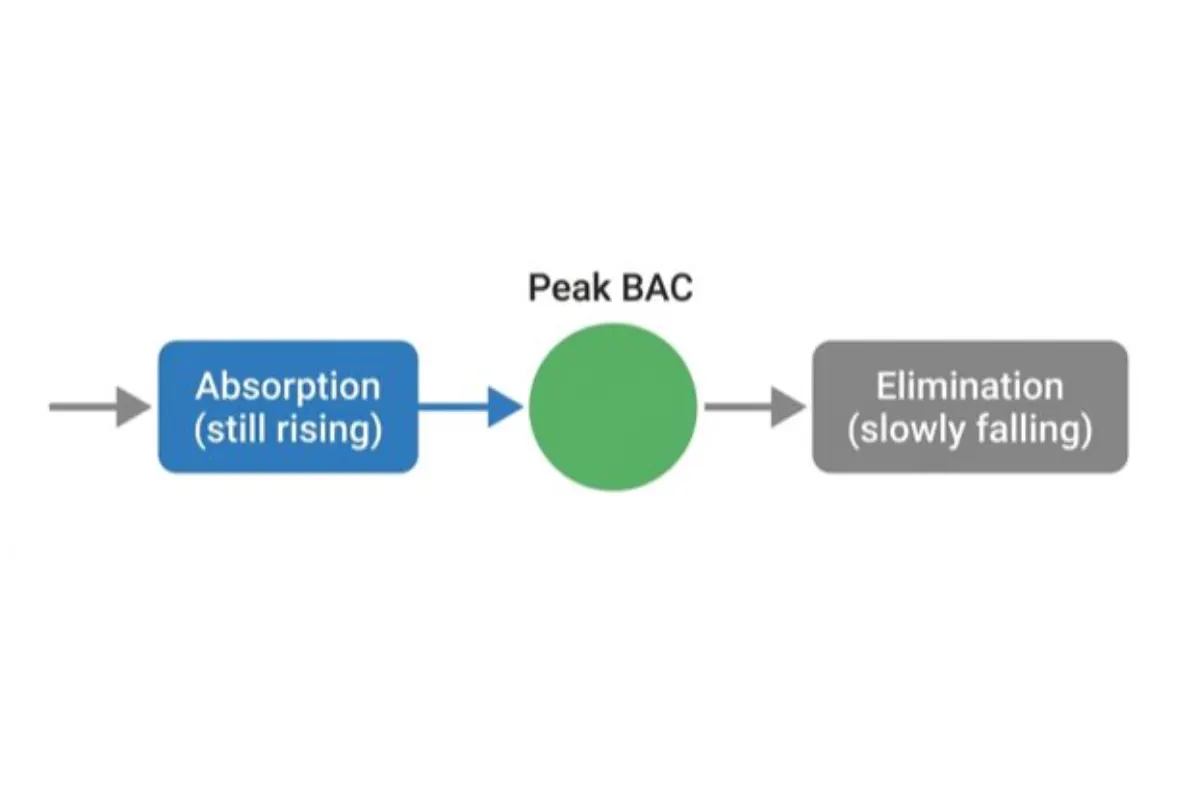
- Absorption. The absorption rate depends on what’s in your stomach, what you drank and how fast you drank it.
- Peak. BAC reaches its highest point when the alcohol still arriving from your gut no longer outpaces what your body removes. That point usually comes some time after the last drink.
- Elimination. Liver enzymes break alcohol down at their own pace, and they can’t be hurried.
Why BAC Can Keep Rising After You Stop
BAC can keep rising after someone stops drinking, and even after they’ve passed out, because alcohol still in the stomach and intestine continues to enter the bloodstream and circulate through the body. Absorption continues after the glass is down, which is why a BAC or breath reading taken later in the evening can be the higher one.
How Your Body Clears Alcohol
Coffee, a cold shower, water and sleep don’t bring BAC down any faster. How long to wait after drinking depends on how much alcohol your body still has to clear, and that amount changes from person to person and night to night.
How Long Does It Take for Alcohol to Kick In After You Eat?
Food in your stomach slows alcohol’s move into the small intestine, so BAC rises more gradually than it would on an empty stomach and a fast spike is less likely. The alcohol still gets absorbed in full, only more slowly. Two things follow from that:
- A meal can move your peak later. You may feel steady at the point where you’d usually feel the first drink, while your BAC is still climbing.
- Food eaten afterward doesn’t lower the alcohol that’s already in your blood.
How What You Drink and How Fast You Drink Change the Timeline
The stronger the drink and the faster it goes down, the faster BAC tends to rise and the higher it tends to peak. Mixers can speed the rise or slow it.
Spirits, Wine and Beer
In a controlled study of peak BAC by drink type, 15 healthy men drank the same dose of alcohol on an empty stomach, once as beer, once as wine and once as a vodka and tonic. The vodka and tonic produced the highest peak and reached it soonest; beer produced the lowest and slowest. Concentration changed the timing even when the total alcohol was identical.
Carbonation and Mixers
Carbonated drinks and carbonated mixers can make BAC rise faster, because carbonation speeds absorption. Fruit juice has the opposite effect: the sugar has to be digested, so BAC tends to rise more slowly. A spirit with soda water and the same spirit with orange juice aren’t absorbed on the same timeline.
Sipping, Chugging and Pace
BAC rises with the number of drinks and with how quickly they’re finished. Several drinks close together give your body less time to clear the first before the next arrives, so more alcohol builds up in your blood at once. Spacing the same drinks out spreads absorption over a longer stretch, which lowers the peak without lowering the total.
Body Factors That Change How Alcohol Affects You
Two people can drink the same thing at the same pace and end up at different BAC levels, because bodies differ in size, makeup and chemistry. No chart can combine these factors into a reliable number for one person on one night.
Body Size and Composition
A larger body gives alcohol more space to spread through, so the same amount usually produces a lower BAC. Muscle has more blood flowing through it than fat does, so someone with a higher share of body fat tends to see BAC rise faster than someone of the same weight with more muscle.
Hormones and Biological Sex
People with higher testosterone levels usually have more muscle, more body water and more of the enzyme that starts breaking alcohol down. People with higher estrogen levels tend to have less body water to dilute the same drink, so they generally reach a higher BAC from it. Hormone changes across the menstrual cycle can also slow how quickly alcohol is processed in the week before a period.
Medications
Some prescription and over-the-counter medicines interact with alcohol in ways that are hard to predict, so ask your doctor or pharmacist about the ones you take. A few, such as some cough syrups and cold medicines, contain alcohol themselves, which is how prescription and over-the-counter drugs can affect an interlock reading.
Fatigue, Stress and Mood
Alcohol has a stronger effect when you’re tired or under stress. That changes how impaired you are without changing the amount of alcohol a breath test measures.
What Does This Mean for a Breath Test and Your Interlock?
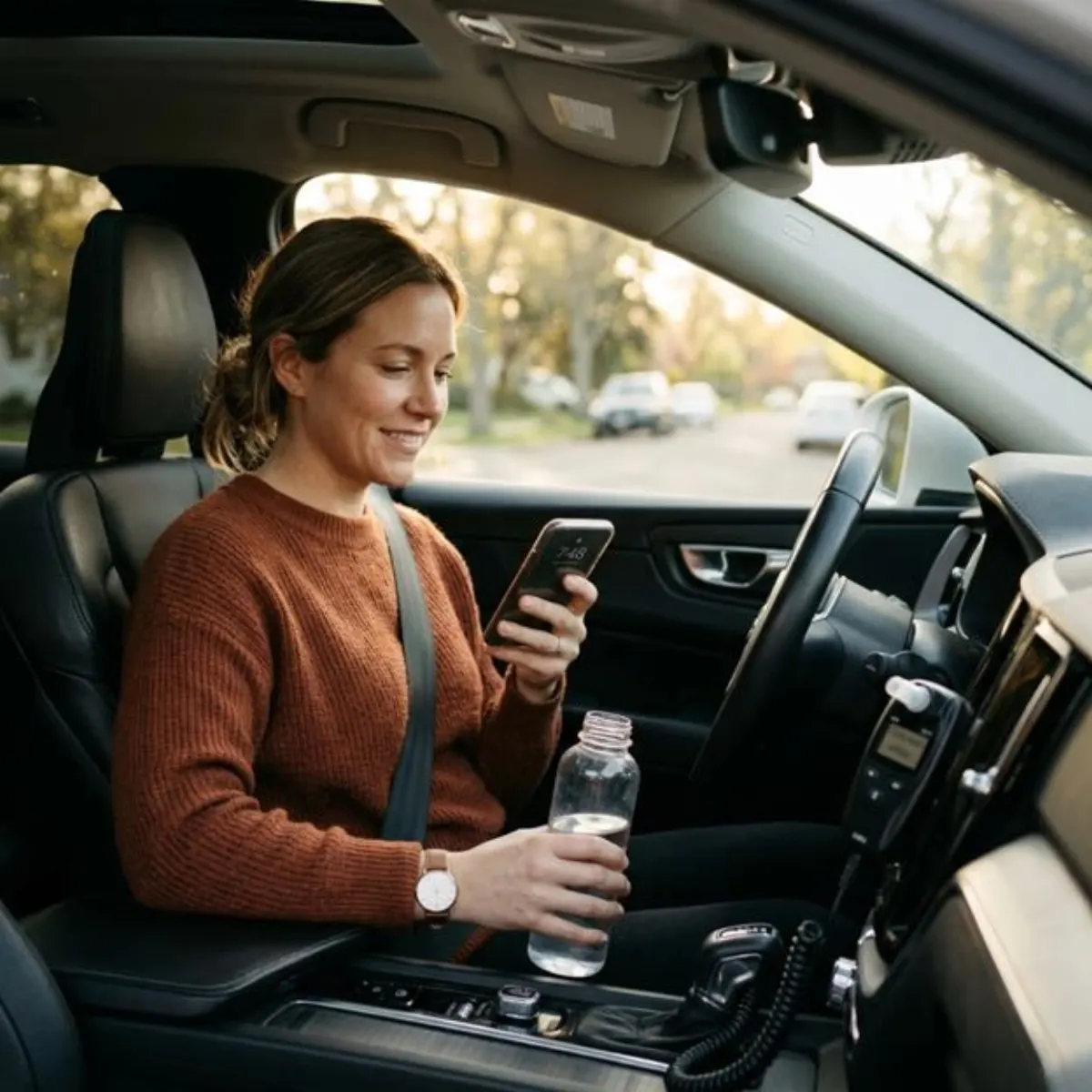
A breath test measures the alcohol in your breath at the moment you blow, so it follows the same rising and falling curve as your BAC. A test taken while absorption is still happening can read lower than a later one, even with nothing new to drink.
An ignition interlock device asks for a breath sample before the engine starts and, depending on your requirements and area, can ask for more during the drive.
Why a Later Test Can Read Higher
A start-up test and a rolling retest partway through the drive can land at different points on the curve. If the first test came while alcohol was still being absorbed, the later one can show a higher reading, even though the driver felt the same or better by then.
Feeling Sober Isn’t a Measurement
How you feel and what your breath contains can drift apart. Regular drinking can build tolerance, which makes BAC feel lower than it is without lowering it. A breath sample measures alcohol, and how steady you feel has no part in the result.
If You Get a Reading You Don’t Understand
Call RoadGuard Interlock support at 1-833-545-0368 before you do anything else. Whether a particular reading counts as a violation depends on your state and your monitoring authority, and support can tell you how your program handles it.
Have these ready when you call:
- The time of the test and whether it was a start-up test or a retest
- What the screen showed
- Anything you ate, drank or used shortly before, including mouthwash, breath spray or medicine
What not to do:
- Don’t guess whether the reading will count against you
- Don’t try to work around the device or have someone else blow for you
- Don’t drive if you’re unsure; arrange another ride and call support
Frequently Asked Questions
Why don’t I feel drunk after drinking?
Your BAC may still be rising, because absorption continues for a while after you drink, and food or a slow pace can stretch that out further. Tolerance is the other common reason. People who drink regularly get used to alcohol’s effects, so the same BAC feels milder to them. The feeling changes; the amount of alcohol in the blood and on the breath stays the same.
What alcohol takes the longest to kick in?
Lower-strength drinks sipped slowly with food usually take the longest. In controlled testing on an empty stomach, beer produced a slower and lower peak than wine or a vodka and tonic at the same dose of alcohol. Fruit-juice mixers also tend to slow the rise, while carbonated mixers speed it up. The circumstances change the timing more than the name of the drink.
What is the 1/2/3 rule for drinking?
Numbered drinking rules like this circulate in several versions, and they’re informal pacing guides rather than measurements. None of them can tell you your BAC. Body size, sex, food, drink strength, medications and pace all shift the result, and the same person can land at a different number on a different night. A rule like this can slow your pace, but it can’t show that your BAC is low enough to drive.
Do you get drunk faster, sipping or chugging?
Chugging. Drinking quickly puts more alcohol into your stomach at once, so BAC rises faster and usually peaks higher than it would if you sipped the same drinks over a longer stretch. Sipping gives your body more time to clear some of the alcohol while the rest is still being absorbed. The total amount of alcohol is the same in both cases, and only the shape of the curve changes.
How long does alcohol take to fully kick in?
There’s no fixed number of minutes. You can notice the first effects well before the peak, and the peak effects keep building until your BAC stops rising, which happens after your last drink and later still if you ate. Because the rise continues after drinking stops, how you feel at the end of the night may not match where your BAC is heading.
When does alcohol peak after drinking?
Alcohol peaks after the last drink, once absorption from the stomach and intestine slows below the rate your body clears it. A meal usually pushes the peak later, while drinking quickly or choosing stronger drinks brings it sooner and higher. No single time fits everyone. A breath test measures where your BAC is at that moment.
Can I drive 12 hours after my last drink?
No set number of hours works for everyone. How long alcohol takes to clear depends on how much you drank, how fast, whether you ate and your own body, and nothing speeds up the clearing except time. After a heavy night, alcohol can still be in your system the next morning. If you drive with an interlock, your breath sample determines whether the car starts.
How long does a drink take to get you drunk?
Alcohol starts to affect you before you’d call yourself drunk. Even small increases in BAC can reduce coordination and cloud judgment, so the effects begin as soon as BAC starts to rise. How quickly that rise happens depends on the drink’s strength, your pace, food and your body, which is why no single timeline fits every drink or every person.
Planning Around the Rise in Your BAC
Your BAC can still be climbing after you feel fine, so settle how you’re getting home before the first drink. If you’re living with an interlock, RoadGuard Interlock’s device uses a simple blow-suck breath test in a sleek, discreet design, and support is available at 1-833-545-0368 whenever a reading surprises you. See how the RoadGuard interlock device works.
Disclaimer: This article is provided by RoadGuard Interlock for general informational purposes only and is not legal, financial, or medical advice. DUI and ignition interlock laws, penalties, fees, and program requirements differ from state to state and county to county, and they can change at any time. Any costs, timelines, or figures mentioned are general estimates rather than quotes or guarantees. Please do not rely on this article as a statement of the law where you live. Confirm current requirements with your state DMV, the court handling your case, a licensed attorney, or RoadGuard Interlock directly before making decisions. Device features, pricing, availability, same-day installation, and any promotions referenced are subject to change, vary by location, and may not be offered in every state RoadGuard Interlock serves.