
Transferring Your Interlock to a New Car: The Complete Guide
Disclaimer
The information in this blog is for general informational purposes only. Information may be dated and may not reflect the most current developments. The materials contained herein are not intended to and should not be relied upon or construed as a legal opinion or legal advice or to address all circumstances that might arise. You should contact your attorney to obtain advice with respect to any particular legal matter. Only your individual attorney can provide assurances that the information contained herein – and your interpretation of it – is applicable or appropriate to your particular situation. Links to any third-party websites herein are provided for your reference and convenience only; RoadGuard Interlock does not recommend or endorse such third party sites or their accuracy or reliability. RoadGuard Interlock expressly disclaims all liability regarding all content, materials, and information, and with respect to actions taken or not taken in reliance on such. The content is provided “as is;” no representations are made that the content is error-free.
You bought a new car. Or your old one finally gave out. Maybe a
dealership trade-in is sitting in your future and you suddenly realized
the device under your dash isn’t going to relocate itself. The first
instinct is to look up the steps. That’s the wrong first move.
The smarter first move is to decide whether you should transfer your
interlock device at all, or whether a fresh install on the new vehicle
is actually the cleaner path. The answer depends on your remaining
program time, your state’s rules, the vehicle you’re moving to, and the
paperwork window between sale and signature. This guide walks through
that decision before it walks through any wrenches.
By the end, you’ll know which option fits your situation, what it
should cost, what paperwork to start now, and which vehicles need extra
planning. For the wrench-by-wrench process itself, we’ll point you to
RoadGuard’s existing step-by-step guides.
Transfer or
New Install: The Decision Comes First
Most drivers assume “transfer” is the default. It usually is, but not
always. A transfer means your existing device is removed from your old
vehicle and reinstalled in the new one, often during the same
appointment. A new install means starting with a different unit,
sometimes a different account configuration, and sometimes a different
agreement entirely.
Three factors decide which one fits your situation:
- How much program time you have left. If you’re 30
days from device removal, a transfer almost always wins on cost and
hassle. If you’re 18 months out, the math gets more interesting. - What the new vehicle is. A standard sedan?
Transfer. A 2025 hybrid with a push-button start and your old install
was in a 2014 pickup? The wiring complexity may favor a clean
install. - Whether you’re staying in the same state.
Same-state transfers are simple. Out-of-state moves often require
provider-to-provider coordination, fresh state paperwork, and sometimes
a different device tier to meet the new state’s specs.
When a Transfer Makes Sense
A transfer is usually the right call when:
- You’re replacing one personal vehicle with another in the same
state. - The new vehicle is a standard make and model your provider services
regularly. - You have several months or more of program time remaining.
- Your monitoring authority is responsive (most are, but a slow
probation office can stretch a one-day transfer into a one-week
ordeal).
In these cases, you’re paying for one appointment with a small
removal fee on the old car and an install fee on the new one. Reporting
continuity stays intact, your serial number stays tied to your case, and
your next calibration date usually rolls forward without resetting.
When a Fresh Install Is
the Better Call
A fresh install can make sense when:
- You’re moving to a new state mid-program and the new state requires
a different device or different reporting infrastructure. - Your old device is reaching the end of its service life or has had
recurring service issues. - The new vehicle has installation challenges (high-voltage EV
systems, classic-car wiring, factory anti-theft layers) that make a
clean start cheaper than retrofitting a transfer. - Your old vehicle has been totaled and is no longer accessible for
removal.
A fresh install can also be the simpler option when a long pause is
unavoidable, like if your new vehicle won’t be ready for several weeks
and you’d otherwise pay storage or no-drive fees on the old unit during
the wait.
Cost Comparison:
Transfer vs. New Install
This is where most decisions get made. RoadGuard publishes its full
pricing on the interlock
device cost page, with installation costs ranging from $50 to $150
depending on the vehicle. Transfers typically combine a removal fee and
a reinstall fee, while a fresh install usually involves a single install
fee but may include account setup costs if you’re switching providers or
states.
| Item | Transfer (same provider, same state) | Fresh Install (new vehicle, same provider) | Fresh Install (new state or new provider) |
|---|---|---|---|
| Removal from old vehicle | $50–$150 | $50–$150 (when applicable) | $50–$150 |
| Installation in new vehicle | $50–$150 | $50–$150 | $50–$150 |
| Account or program setup | Usually none | Usually none | May apply |
| Calibration reset | Often included | Often included | May apply |
| Same-day scheduling | Often available | Often available | Varies by state |
| Reporting continuity | Preserved | Preserved | New reporting setup |
Two notes on this table. First, costs vary by state and vehicle, so
treat the ranges as planning numbers rather than quotes. Second,
RoadGuard offers a First
Month Free promotion and a Price Match Guarantee, both of which can
change the math when you’re comparing options. Always ask for a full
out-the-door number before you book.
One honest caveat: if the new vehicle has complex wiring, a
push-button ignition, or layered anti-theft systems, install costs lean
toward the higher end of the range. Ask your provider about your
specific make and model before you commit to a date.
Timing: When to Start the
Paperwork
This is the most under-discussed part of transferring your interlock.
Most drivers wait until the new car is sitting in the driveway. That’s
usually too late.
Start the paperwork the moment you’re seriously considering the
change. Here’s a realistic timeline:
- Two to four weeks out. Call your provider. Tell
them you’re planning a vehicle change and ask what your state requires.
Some states need only provider notification. Others require written
approval from the DMV, the court, or a probation officer. - One to two weeks out. Submit any required
notification forms to your monitoring authority. Gather your documents
(more on those below). - Two to three days out. Confirm the appointment,
confirm authorization came through, and confirm the new vehicle has
clean registration and insurance in your name (or written permission if
it’s not yours). - Day of the change. The old device comes out, the
new one goes in, and your reporting transfers.
Many providers, including RoadGuard, offer same-day
installs when scheduling and authorization line up. That’s the
version of this process you want. The version you don’t want is selling
your old vehicle on a Friday with no plan, then realizing on Monday that
you can’t legally drive anything.
For the actual step-by-step process of the transfer appointment
itself, see RoadGuard’s step-by-step
transfer guide. For state-by-state requirements, see the state-by-state
transfer breakdown. This guide is the decision-making layer that
sits above both.
Vehicle Eligibility:
What Actually Works
Most modern passenger vehicles work with an ignition interlock
device. A few categories need extra planning.
Standard internal-combustion sedans, SUVs, and
pickups. No special considerations. Transfer or install runs as
expected.
Push-button start and keyless ignition. Fully
compatible. Install takes a bit longer because the technician integrates
with the vehicle’s start module, but it’s routine work.
Hybrids and fully electric vehicles. Compatible with
proper installation procedures. Wiring approach differs from a gas
vehicle, and not every shop handles EVs well. RoadGuard’s network
includes technicians trained on EV installs, but confirm when you
book.
Leased vehicles. Require written permission from the
leasing company before installation. Most lessors grant this without
issue. Get it in writing.
Employer-owned or company vehicles. Require written
authorization from the employer and may need additional documentation
from your monitoring authority.
Motorcycles. Most states do not allow interlock
installation on motorcycles, and most providers do not offer it. If a
motorcycle is your only vehicle, talk to your monitoring authority about
alternatives before assuming anything.
Classic cars and heavily modified vehicles. Case by
case. Older vehicles with non-standard electrical systems may require an
in-person assessment before booking.
A quick note on hybrids and EVs specifically: the install location,
the power source the device taps into, and the way the device interacts
with the start sequence all differ from a gas vehicle. None of that is a
dealbreaker, but it’s worth a phone call to confirm your specific
vehicle is straightforward before you put money down.
Out-of-State Moves
vs. Same-State Transfers
These are two different animals.
A same-state transfer is what most drivers are
doing. The provider handles removal and reinstall, the monitoring
authority gets notified, and reporting continues without a break. Most
can be wrapped up in a single appointment.
An out-of-state move is materially more involved.
You’re often dealing with:
- A different state’s interlock program with its own device specs and
reporting requirements - Provider-to-provider coordination if your current provider doesn’t
have a service center in your destination state - Fresh paperwork with the new state’s DMV or monitoring
authority - A potential gap between when your old state’s program ends and the
new state’s begins
RoadGuard has a broad service network across the country. If your
move keeps you within that network, the coordination is much smoother.
RoadGuard’s guide on moving
out of state with an interlock covers the interstate compliance side
in more depth.
The single most important rule for an interstate move: start the
conversation at least 30 days before the move date. Inter-jurisdictional
delays are the norm, not the exception.
What Could Go Wrong
(and How to Avoid It)
A transfer that goes well is invisible. You barely notice it
happened. A transfer that goes badly creates a paper trail that can
extend your program. The most common failure modes:
Selling the old car before authorization comes
through. Don’t do this. If your old vehicle leaves your
possession before the device is properly removed and the transfer is
authorized, you’ve created a reporting gap that looks like a violation
to some monitoring authorities.
Driving an uninstalled vehicle during the transition
window. Most jurisdictions treat driving any vehicle without an
installed device as noncompliance, even temporarily. If your old car is
gone and your new car isn’t done yet, you should not be driving.
Missing the monitoring authority notification step.
Provider notification is not the same as DMV or court notification in
many states. Confirm exactly who needs to know.
Document gaps. Missing registration, insurance, or
written owner permission can turn a one-hour appointment into a
rescheduled appointment with a missed-appointment fee.
Assuming reporting transferred automatically. Before
you leave the shop, confirm the new device is communicating with the
monitoring system and your account shows the correct vehicle.
Frequently Asked Questions
How
do I know whether to transfer my interlock device or do a fresh
install?
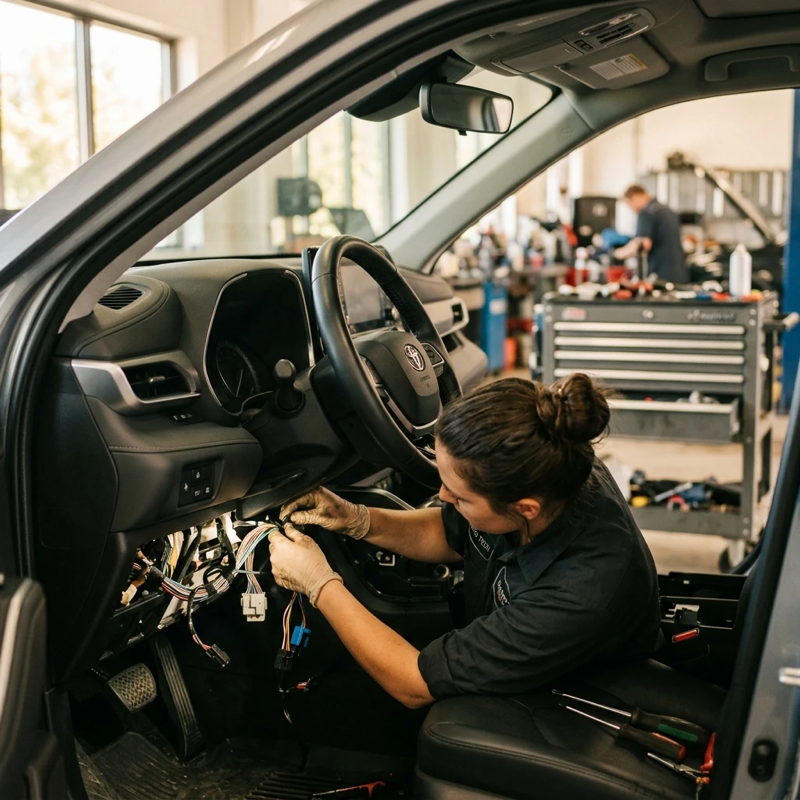
In most same-state vehicle changes, a transfer is the cheaper and
faster option. Consider a fresh install when you’re moving to a new
state, your old vehicle is totaled or no longer accessible, your device
is near end-of-life, or the new vehicle has installation complexity that
makes a clean start more practical. Your provider can walk through the
math with you before you book.
How
much does it cost to transfer an interlock device to a new car?

Typical transfers combine a removal fee and an installation fee, with
each generally falling in the $50 to $150 range depending on the vehicle
and state. Many providers bundle both into a single transfer cost.
RoadGuard’s full pricing detail is on the interlock
device cost page, and the First Month Free promotion may apply to
your situation.
How
long before I switch vehicles should I start the transfer
paperwork?
Two to four weeks is the safe window. That gives your provider time
to confirm what your state requires, lets you submit any monitoring
authority notifications, and leaves room for paperwork delays. For
out-of-state moves, push that timeline to at least 30 days.
Can I
drive my new car before the interlock is installed?
In most jurisdictions, no. Driving any vehicle without an approved
installed device while you’re under an interlock order is treated as
noncompliance. If you need to move the new vehicle to a service center,
ask your provider about tow options, third-party drivers, or scheduled
at-home installation where available.
Does an
interlock transfer reset my program time?
In most states, no. Your program clock is tied to your case, not your
vehicle. A properly authorized transfer keeps your existing program time
intact. What can cause problems is a reporting gap during the
transition, which is why getting authorization first matters so
much.
Will my
next calibration date change after a transfer?
Often it stays the same, but it can shift slightly depending on state
rules and provider policy. Before you leave the appointment, ask the
technician for written confirmation of your next required service date
so nothing gets missed.
What if my
old car is totaled or no longer drivable?
Contact your provider immediately. Most states allow a temporary
period without a device while you arrange the transfer or fresh install,
but you typically cannot drive any vehicle during that window. Document
everything: the accident report, insurance communication, and the date
you first contacted your provider. RoadGuard’s support hub has
guidance on handling unexpected vehicle changes.
Can I
transfer my interlock to a vehicle that isn’t in my name?
Often yes, with written owner permission and any additional
documentation your state requires. Leased vehicles need written
authorization from the leasing company. Employer-owned vehicles need
written authorization from the employer. Always get permissions in
writing before the appointment.
Do
hybrids and electric vehicles work with an interlock device?
Yes. Most modern hybrids and EVs accept interlock installation,
though the wiring approach differs from a gas vehicle. Confirm when
booking that your provider’s technician is experienced with your
specific vehicle type. RoadGuard’s network includes EV-trained
technicians.
What
happens if I move to a different state during my program?
You’ll need to coordinate between your current state’s program and
the new state’s requirements, which often means provider-to-provider
coordination and fresh paperwork with the new state’s DMV or monitoring
authority. Start at least 30 days before the move. Some states have
reciprocal agreements, many don’t.
Will
an interlock affect my new vehicle’s warranty or insurance?
Some insurers and warranty providers have rules about aftermarket
electrical work, even when it’s court-ordered. Before installation, ask
your insurer and warranty administrator what documentation they want,
and keep your work order and authorization paperwork on file.
Ready to Plan Your Transfer
A vehicle change doesn’t have to interrupt your program. The drivers
who get through this cleanly are the ones who make the decision early,
line up the paperwork before the appointment, and pick a provider with
the network and scheduling flexibility to handle it in a single
visit.
RoadGuard offers same-day installation availability at service
centers nationwide, with transparent pricing and coordination with your
monitoring authority built into the process. Call
1-833-545-0368 to talk through your situation and book
your transfer or fresh install. Less downtime, fewer compliance worries,
and a clear plan before you turn the key.