
Navigating Interlock Requirements with No Vehicle Ownership
Disclaimer
The information in this blog is for general informational purposes only. Information may be dated and may not reflect the most current developments. The materials contained herein are not intended to and should not be relied upon or construed as a legal opinion or legal advice or to address all circumstances that might arise. You should contact your attorney to obtain advice with respect to any particular legal matter. Only your individual attorney can provide assurances that the information contained herein – and your interpretation of it – is applicable or appropriate to your particular situation. Links to any third-party websites herein are provided for your reference and convenience only; RoadGuard Interlock does not recommend or endorse such third party sites or their accuracy or reliability. RoadGuard Interlock expressly disclaims all liability regarding all content, materials, and information, and with respect to actions taken or not taken in reliance on such. The content is provided “as is;” no representations are made that the content is error-free.
Most people don’t think about the interlock order until they realize
the obvious problem: there’s no car in the driveway. Maybe you sold it.
Maybe you never owned one. Maybe the DUI itself ended the lease. Either
way, the order is on your license, the clock is ticking somewhere in the
background, and nobody at the DMV counter handed you a clear plan for
how to live the next 6 to 24 months.
That’s what this guide is for. The eligibility question — whether you
need an interlock at all when you don’t own a car — gets covered in
detail in our companion piece on whether
you have to install an interlock if you don’t own a car. The piece
you’re reading now picks up after that decision is made. How do you
actually navigate the program day to day, get around without a car, and
stay ready for the moment you do get one?
The Four Ways States
Handle Non-Car-Owners
States fall into roughly four buckets when a driver has an interlock
order but no vehicle. Knowing which bucket your state sits in is the
single most useful thing you can do this week.
| State approach | What it means for you | Your compliance clock |
|---|---|---|
| Active installation required | The interlock order stays attached to the license. You hold a restricted (interlock-only) status until a device is installed and reporting data. |
Doesn’t start until install. |
| Exemption affidavit / non-owner declaration | You sign a sworn statement that you don’t own or operate a vehicle. The restriction stays on your license, but you don’t have to install yet. You re-apply if you acquire a vehicle. |
Often doesn’t start until install; some states give partial credit. |
| Clock paused until vehicle acquired | Similar to the affidavit path, but the state formally pauses the compliance timeline. When you get a vehicle, you install and pick up where you left off. |
Paused, then resumes. |
| Lookback period counts regardless | A handful of states count calendar time toward the lookback period regardless of installation status. Rare. |
Runs in the background. |
Verify which one applies to you. Your court order, the state DMV page
for your jurisdiction, and your monitoring authority all need to
agree. If they don’t, the one that controls is whoever sends compliance
reports to the court. Call them first.
A note worth saying out loud: most states sit in the first bucket.
The restriction stays on your license, and time doesn’t count until a
device is reporting. That’s the default to plan around, with the
affidavit path as the exception you confirm in writing.
What
“Restricted License with No Device” Actually Looks Like
If you go the affidavit route, your license is functionally a piece
of paper that says you can’t legally start a car without an interlock.
You can carry it. You can use it as ID. You can drive a borrowed vehicle
only if that vehicle has an interlock on it. You cannot rent a car. You
cannot test-drive at a dealership. You cannot drive a friend’s car “just
to the store.”
This sounds harsh, and in the day-to-day it mostly is. The upside is
that you’re not paying monthly device fees during a period where you
have no vehicle to run them on. The downside is that your license is
still restricted, your insurance carrier still sees the DUI, and the
calendar isn’t necessarily moving you toward reinstatement.
The honest read: an affidavit is the right move only if you’re
confident you won’t be acquiring a vehicle soon and your state actually
gives credit for the affidavit period. If neither of those is true,
installing on a borrowed or family vehicle starts your clock and
shortens your overall timeline.
Getting
Around Without a Car (and Without a Workaround)

Here’s where the planning actually pays off. The interlock period can
run anywhere from 6 months to several years, so the transportation
question isn’t “how do I get to court next week,” it’s “what’s my
realistic daily life for the next year or two.”
Transportation
options that don’t risk a violation
| Option | What it’s good for | Trade-offs |
|---|---|---|
| Rideshare as a passenger (Uber, Lyft) | Door-to-door, late nights, bad weather, infrequent trips | Adds up fast; budget $400–$800/month for moderate use in most metros |
| Public transit | Predictable daily routes (work, school) | Coverage and frequency vary wildly by city; weekends are often worse |
| Bicycle / e-bike | Short urban trips, fitness, no recurring cost | Weather, distance, and storing the bike securely |
| Walking | Trips under a mile, errands close to home | Not a real plan for most American suburbs |
| Family or friend rides | Recurring weekly trips, predictable times | Wears thin if you ask too often; agree on a small reciprocation |
| Employer-provided transport | Job sites that run a shuttle or work truck | Limited to work duties; can’t be used for personal errands |
| Court-approved alternative transportation | Medical appointments, treatment visits | Some courts will document a vetted plan in lieu of an interlock for hardship cases — ask |
The combination most non-owners end up with is a mix: transit or
carpool for the workday, rideshare for evenings and weekends, family for
big trips like grocery runs or doctor visits, and a bike or walking for
anything within a mile. It’s less convenient than driving. It’s also a
real life that thousands of people in your situation live every
month.
One word on rideshare specifically: this guide is about
riding in someone else’s vehicle, not driving for a rideshare
platform yourself. Driving for Uber or Lyft while on an interlock has
its own set of rules and platform restrictions — that’s a separate
topic.
When You
Later Get a Vehicle: The 24- to 72-Hour Window
This is the section most non-owners under-plan for. The moment you
take possession of a vehicle, your compliance picture changes
immediately.
What you need to do, in order
- Notify your monitoring authority. Most states
require notification within 24 to 72 hours of acquiring a vehicle. Some
require it before you drive. Check your specific order. - Schedule installation before you drive the car.
Driving a non-equipped vehicle even once, even to the install
appointment, can be charged as operating without an interlock. Some
shops will tow or transport the vehicle if needed; call ahead. - Bring the right paperwork to the install. Your
court order or DMV restriction letter, vehicle registration, proof of
insurance, photo ID, and any state-specific install authorization
form. - Confirm that the compliance clock starts on installation
date. Get this in writing from your provider. The first
reporting cycle usually begins the day the device is calibrated and
activated. - Update your insurance carrier. Some carriers
require notification when an interlock is installed; SR-22 filing may
already be in place from the DUI.
Same-day installation is common. RoadGuard offers it at most of its
service
locations on the Dräger Interlock 7000 and Dräger Interlock XT —
both designed for installation in any type of vehicle, including
motorcycles. If you’re acquiring a less common vehicle (older model,
push-button start, hybrid), call ahead so the technician can confirm
parts and procedure.
What not to do
Don’t drive the new vehicle to “test it out” before installation.
Don’t park it at home for a few days while you decide. Don’t let your
spouse or roommate drive it without the device installed if your state’s
order extends the requirement to household vehicles. Each of these
creates a documentation problem you’d rather avoid.
Living with the Order Day to
Day
The non-car period of an interlock case has a particular rhythm
that’s worth naming.
Track your timeline in
writing
Keep a simple file — paper or digital — with your court order, your
DMV restriction letter, your affidavit (if applicable), and any
correspondence from your monitoring authority. When you finally do
install, the calendar dates matter. Knowing exactly when the order was
issued, when the affidavit was filed, and when you expect installation
lets you push back accurately if a deadline gets misread.
Stay
current on the requirements that don’t need a device
A lot of the program isn’t device-related. Required treatment
classes, victim impact panels, restitution payments, SR-22 insurance,
reinstatement fees — these all run in parallel and many of them can be
completed during the no-vehicle period. Knocking them out now means a
smoother reinstatement later. The restricted
license process varies by state, but the non-device requirements are
usually well-documented on the DMV site.
Re-check the rules every
few months
State interlock rules genuinely change. Pennsylvania revised its
program in 2024. Several states adjusted lookback periods through 2025.
If your case spans two years, the rules that applied at the start might
not be the rules at the end. A quick quarterly check on your state DMV
page costs ten minutes and occasionally reveals a benefit (shorter
compliance period, lower fees, expanded exemption) that wasn’t available
when you started.
When the Device Goes On:
What to Expect
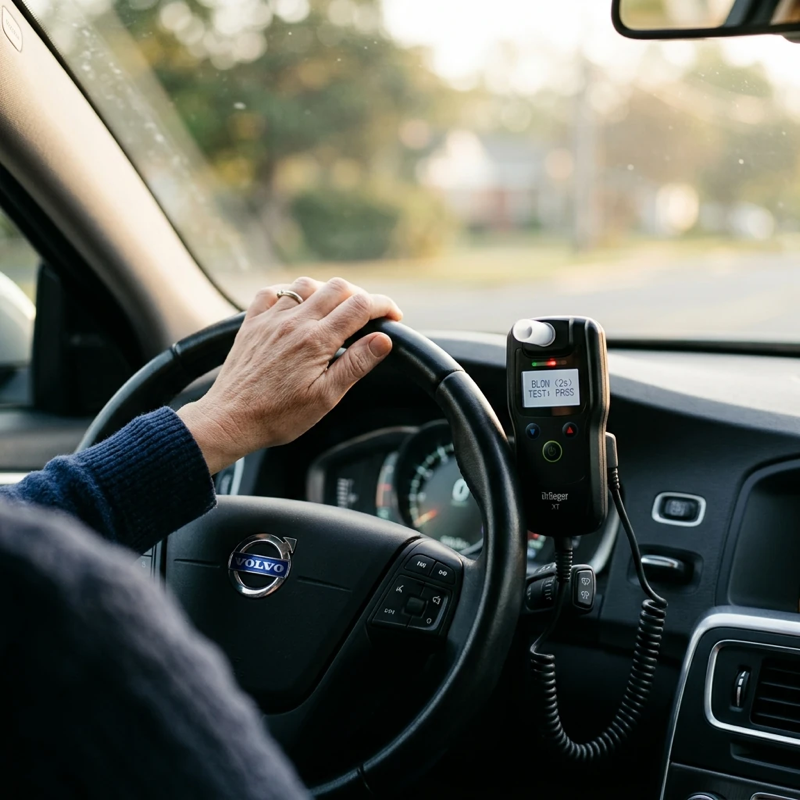
When the day comes to install, the device itself is small enough that
most people are surprised. The Dräger Interlock
7000 has a sleek, discreet design with a rear-mounted mouthpiece and
a simple blow-suck breath test — no humming, no rhythm tricks. The test
takes about ten seconds. The unit operates from -40 °F to 185 °F, so
cold-weather starts in winter and hot-soak conditions in summer are both
within spec.
You’ll do an initial start-up test, then occasional rolling retests
while driving. The complete
guide to using an ignition interlock walks through the daily
mechanics if you want to read through the routine before you
install.
Calibration happens on a schedule set by your state — generally every
30 to 60 days. Missing one is the most common avoidable violation in the
entire program. Put the next appointment in your calendar before you
leave the current one.
Frequently Asked Questions
Can
I file a no-vehicle affidavit instead of installing right away?
In some states, yes. Roughly a third of states accept an exemption
affidavit or sworn non-owner declaration that pauses installation until
you acquire a vehicle. Some states give partial calendar credit; most do
not. Read your court order carefully and confirm directly with your
monitoring authority before relying on the affidavit path. If your state
doesn’t offer it, installing on a borrowed or family vehicle is usually
the faster route to reinstatement.
How
quickly do I need to install once I get a vehicle?
Most states require notification within 24 to 72 hours and
installation before you drive the vehicle. A few states allow up to 10
business days. Driving even once without the device after acquiring a
vehicle can be charged as operating without an interlock and can extend
your overall compliance period. Same-day installation is widely
available, so the safest plan is to schedule the install appointment
before you take possession of the car.
Does the
interlock requirement apply to motorcycles?
Yes, in most states an interlock restriction covers all motor
vehicles, including motorcycles and scooters. The Dräger Interlock 7000
is designed to install on any type of vehicle, motorcycles included.
Verify your state’s specific definition of “motor vehicle” in the
restriction — some states carve out mopeds under a certain engine size,
others don’t.
What if
I only need to drive occasionally, like once a month?
The order doesn’t care about frequency. If you have access to a
vehicle and your state requires interlock for any driving, the device
has to be on that vehicle whenever you operate it. The exception is the
affidavit path, which assumes you genuinely don’t have access. Borrowing
a car twice a month while telling the DMV you have no access creates a
documentation risk that isn’t worth taking.
Can
I use rideshare services like Uber or Lyft during the program?
As a passenger, yes — rideshare, taxi, public transit, and rides from
family or friends are all fine. The restriction is on you operating a
motor vehicle, not on being transported by one. Many people on interlock
budget $400 to $800 per month for rideshare during their no-vehicle
period; it costs more than driving but less than buying and insuring a
car you wouldn’t otherwise need.
What
happens to my license while I have no vehicle and no installed
device?
In most states the license remains in a restricted status —
physically valid as ID, legally limited to driving an interlock-equipped
vehicle. You can carry it. You can renew it during its term. You
generally can’t use it to rent a car or drive any vehicle that doesn’t
have a device installed. The restriction stays until you complete the
program through the installation-and-monitoring path.
Does
the lookback or “interlock” period count while I have no device
installed?
It depends on the state. Most states only count time when a device is
installed and reporting compliance data. A small number of states count
calendar time regardless. A few pause the clock entirely under an
affidavit and resume when you install. Get the answer in writing from
your monitoring authority before deciding to wait.
Can
my family member or roommate drive the vehicle I install on?
Yes, but they have to use the device to start it, the same way you
do. The device logs every breath test and every start, so any other
driver’s tests are part of your compliance record. Walk household
members through how the device works before they drive. A failed test
from another driver still has to be explained to your monitoring
authority.
What
does it cost to install and maintain the device when I do get a
vehicle?
Installation typically runs between $50 and $150 depending on the
vehicle type, and monthly monitoring sits in a similar range. Removal is
in the same band. Specific calibration and reporting fees vary by state.
RoadGuard offers transparent pricing, a price match guarantee, and a first
month free promotion at participating locations. Florida and a
handful of other states have financial assistance programs for drivers
who qualify.
What if I
move out of state while I have no vehicle?
Notify your monitoring authority before the move. Most interlock
orders transfer between states through a process the receiving state’s
DMV manages. You’ll likely need to file an updated affidavit in the new
state, and the rules around installation credit may shift. The moving-out-of-state
interlock guide covers the interstate compliance process in
detail.
When You’re
Ready to Install, We’re Ready to Help
The interlock order will outlast the no-vehicle period for most
people. When you do acquire a vehicle — whether next month or next year
— installation is the moment the compliance clock actually starts
moving. Same-day appointments are available across the country, and the
RoadGuard support
hub walks through the paperwork and prep so the install day itself
is short.
Call 1-833-545-0368 when you’re a week or two from
getting a vehicle. We’ll confirm your state’s notification window, line
up the install slot, and have your compliance documentation ready before
you take possession of the car.