
Ignition Interlock Removal Process: What Happens at Your Final Appointment and How to Prepare
Disclaimer
The information in this blog is for general informational purposes only. Information may be dated and may not reflect the most current developments. The materials contained herein are not intended to and should not be relied upon or construed as a legal opinion or legal advice or to address all circumstances that might arise. You should contact your attorney to obtain advice with respect to any particular legal matter. Only your individual attorney can provide assurances that the information contained herein – and your interpretation of it – is applicable or appropriate to your particular situation. Links to any third-party websites herein are provided for your reference and convenience only; RoadGuard Interlock does not recommend or endorse such third party sites or their accuracy or reliability. RoadGuard Interlock expressly disclaims all liability regarding all content, materials, and information, and with respect to actions taken or not taken in reliance on such. The content is provided “as is;” no representations are made that the content is error-free.
Most people spend months thinking about the day their interlock removal finally happens, yet almost nobody knows what the actual appointment looks like. You show up, a technician does some work under the dash, and you drive away free. That's the version you hear. The reality involves a specific sequence of steps, paperwork that needs to go to the right agencies, and a gap between device removal and full license restoration that catches people off guard.

Here's what generally happens at your final interlock appointment: what to bring, what the technician removes and what stays, and the post-removal steps that decide when your restricted license clears. Skip any of these details and you risk delays that can stretch your interlock period longer than it needs to be. One note first: removal rules, forms, and timelines vary by state and provider, so confirm your specifics with your provider and your DMV or monitoring authority.
How the Interlock Removal Process Works From Start to Finish
The ignition interlock removal process is not a single event. It's a chain of steps that starts well before you walk into the shop and doesn't truly end until your DMV record reflects an unrestricted license. Treating the appointment itself as the finish line is the most common mistake drivers make.
Confirm Your Eligibility and Get Written Authorization
Before you schedule anything, you need official confirmation that your required interlock period is complete. In most states, this means your monitoring authority, whether that's a court, probation office, or DMV, issues a removal authorization letter or order. Some states generate this automatically when your compliance data shows a clean, violation-free window. Others require you to request it.
Many states now tie removal eligibility to a violation-free record, meaning a failed test or missed calibration near the end of your term can shift your completion date. Because these compliance-based rules and their details vary widely, check with your monitoring provider and your state's DMV before assuming your original end date still holds.
One important distinction: eligibility for removal and authorization for removal are two different things. You might be eligible based on time served, but without the actual paperwork authorizing a technician to pull the device, no reputable shop will touch it. If you're unsure whether you've reached your eligibility window, review when you can get your interlock removed and confirm with your provider before booking.
Schedule Your Final Appointment and Gather Your Documents
Once you have authorization in hand, contact your interlock provider to schedule the removal. Many shops can accommodate you within a few business days, though end-of-month slots often fill faster since many compliance periods align with calendar months.
Bring these items to your appointment:
- Removal authorization letter from your court, probation officer, or DMV
- Valid photo ID (the same one tied to your interlock account)
- Proof of completed monitoring period if your provider doesn't already have it on file
- Payment for any outstanding balance on your lease, including the final month's service fee and any removal charges
Some states also require proof of up-to-date calibration at the time of removal. If your last calibration appointment lapsed, the technician may need to perform one final calibration before the device comes out. That can add time and potentially cost, so staying current on your service visits right up to the end matters more than people realize.
What Actually Happens During the Removal Appointment
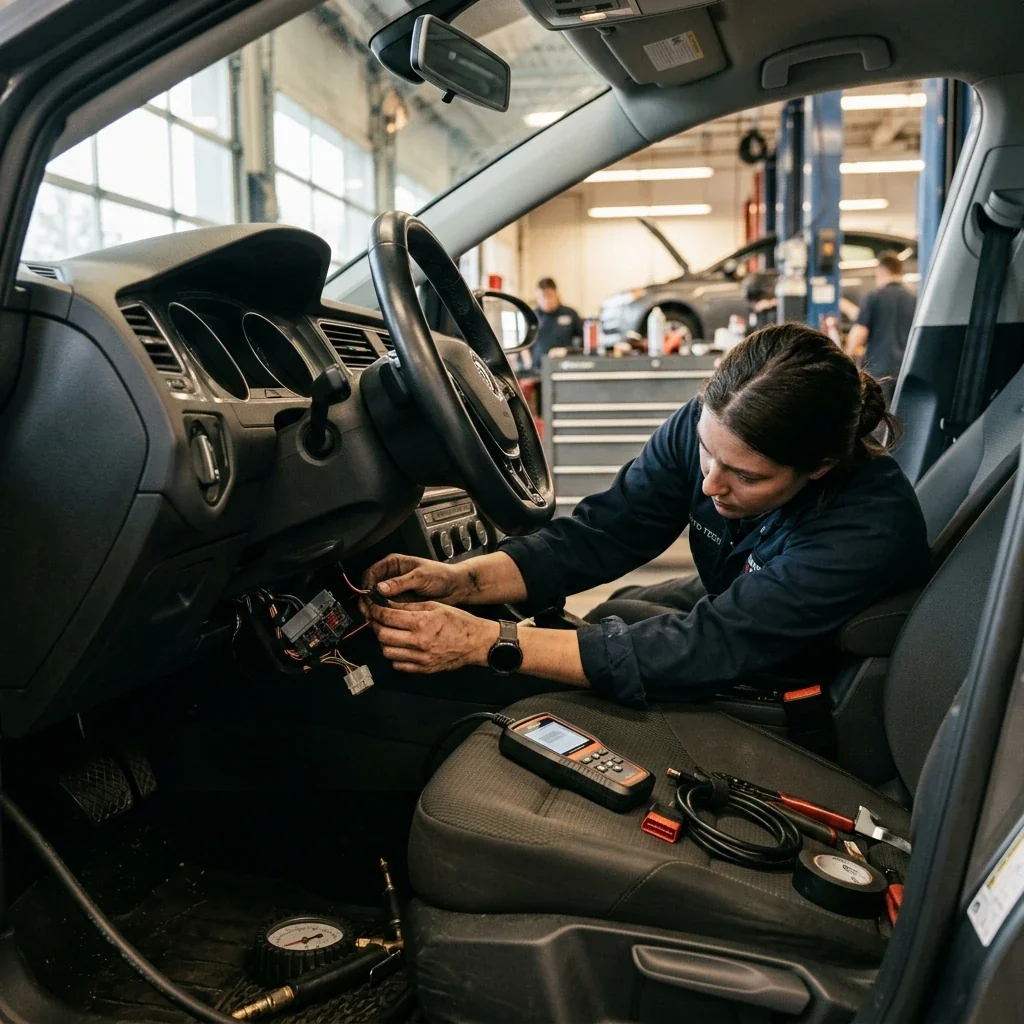
The appointment itself typically takes 30 to 60 minutes. Here's what the technician does, step by step.
The Final Data Download and Device Uninstall
First, the technician performs a final data download from your device. This captures your last round of breath test results, any rolling retest data, and timestamps confirming your compliance through the end of your required period. This download is not optional. It generates the compliance record that your state's DMV or monitoring authority needs before they'll clear your license restriction.
Standardized removal checklists and electronic reporting generally speed up how quickly your compliance data reaches the agency that clears your restriction, so the efficiency of your provider's reporting can affect how fast your license clearance moves.
After the download, the technician disconnects the interlock head unit (the handset you blow into), the relay wiring that connects to your ignition system, and any camera or GPS module if your program required one. They reconnect your vehicle's original ignition wiring so the car starts normally again.
What Gets Removed vs. What Stays in Your Vehicle
The head unit, wiring harness, and any mounting brackets come out. Small cosmetic traces sometimes remain: a tiny hole where the handset mount was secured to the dash, minor wire-routing clips behind panels, or adhesive residue from camera placement. None of these affect how the car runs, but if you lease your vehicle or plan to sell it soon, ask the technician to clean up as thoroughly as possible.
Your vehicle's original wiring gets restored to factory condition. A good technician solders connections and wraps them properly rather than using quick-splice connectors. If you notice any electrical quirks after removal (a dashboard warning light, for example), contact the shop immediately. This is rare with professional providers, but worth mentioning.
The Paperwork You Walk Away With
Before you leave, the shop should hand you a printed de-installation receipt or certificate. This document confirms the date of removal, your device serial number, and verification that the final data download was completed. Do not leave without this paper. You'll need it for your DMV filing, and replacing a lost copy takes time.
Your provider also electronically transmits a de-install report to your state's monitoring authority. Levels of integration vary by state, so don't assume your license restriction lifts the moment you drive out of the shop.
What Happens to Your License After the Device Comes Out
This is where most confusion lives. Removing the physical device and removing your interlock license restriction are two separate events. The device comes out at the shop. The license restriction comes off at the DMV, and that second step usually requires action on your part.
Filing With Your DMV and Monitoring Authority
In most states, you need to submit your de-installation certificate to the DMV (and sometimes your court or probation office) to trigger the removal of the interlock restriction from your driving record. Some states handle this automatically through electronic reporting from your provider. Others require you to file in person or by mail.
Until that restriction officially clears, your license still technically carries the interlock condition. If you get pulled over during this window, you could face questions about why you're driving without a device while your record shows a restriction. Carry your de-installation certificate in your glove box until your updated license arrives or your DMV record reflects the change.
The timeline varies significantly. Some states process the change quickly, while others take a few weeks. Call your local DMV after filing to confirm expected processing time so you're not left guessing.
State Differences You Should Expect
Every state handles interlock removal paperwork differently. The forms, the agencies involved, the required violation-free periods, and even who authorizes the removal all vary. A driver in one state deals with a different process than someone in another. Always verify your specific state's requirements with both your provider and your DMV rather than relying on general advice alone.
RoadGuard Interlock's service network covers the many states it serves, and our certified technicians handle the final data download and electronic reporting based on your state's specific requirements. If you're approaching the end of your program, you can find your nearest interlock installation and removal location to confirm scheduling availability and any state-specific documents you'll need to bring.
Why You Should Never Remove the Device Before Getting Authorization
This one is worth stating plainly: removing your interlock device before you have official authorization can reset your entire compliance clock. In many states, unauthorized removal triggers a program extension, a restart of your required violation-free period, or additional legal penalties.
No matter how close you are to your completion date, the device stays until you have paperwork confirming it's time. Even a single day early can create problems that take months to undo. Interlocks are widely credited with stopping large numbers of attempts to drive over the limit, as Mothers Against Drunk Driving documents, and the compliance framework exists to protect everyone on the road. The finish line is real, but you have to cross it properly.
If you believe you might qualify before your original end date, that's a separate process entirely. You can explore whether early interlock removal is an option in your state, but it requires a formal petition, not a unilateral decision to pull the device.
Frequently Asked Questions
Can I drive my car immediately after the interlock device is removed?
In most cases, yes, your vehicle should start and operate normally right away. If your state still shows an interlock restriction on your record during processing, keep your removal receipt with you and confirm any temporary driving rules with your DMV.
What should I do if my vehicle has electrical issues after removal?
Document the symptoms, note when they started, and contact the removal shop as soon as possible for an inspection. Avoid attempting DIY electrical fixes, since that can complicate troubleshooting and may affect warranty coverage from the installer.
How do I confirm the interlock restriction is actually removed from my driving record?
Check your license status through your state's official DMV portal or request a driving record, then verify the restriction code is gone. If it still appears after the expected processing window, follow up with the DMV and ask whether they need additional documentation.
Will removing the interlock affect my car warranty or leased vehicle terms?
It can, depending on your lease agreement or warranty policies, especially if non-approved modifications are involved. If you lease or have a warranty, ask the provider for documentation of professional removal and keep it with your service records.
What happens to the device after it is removed, and do I need to return anything?
The shop typically retains the equipment and closes out the lease or service account based on their return procedures. Before your appointment ends, confirm that all components are checked in, your account balance is settled, and you have a final receipt showing a zero balance if applicable.
Can I switch providers right before my final appointment?
Switching at the end can create reporting gaps if your compliance data is split across vendors or transferred incorrectly. If you're considering a switch, coordinate with both providers and your monitoring authority in advance to ensure uninterrupted reporting and a clean final closeout.
Are there insurance changes I should make after interlock removal?
Ask your insurer whether your policy can be re-rated once your license status and any filing requirements change. Keep proof of removal and updated license documentation available, since some carriers adjust premiums based on restrictions and compliance milestones.
Cross the Finish Line the Right Way
The interlock removal process has a clear sequence: confirm eligibility, get authorization, attend your final appointment, collect your de-installation paperwork, and file with your DMV. Skip or rush any step and you risk delays that nobody wants after months of compliance.
RoadGuard Interlock has guided drivers through this process, with certified technicians in the many states it serves who handle state-specific reporting so your compliance data reaches the right agencies quickly. When you're ready to schedule your final appointment, contact us today to get back on the road with a clean record and an unrestricted license.
Disclaimer: This article is provided by RoadGuard Interlock for general informational purposes only and is not legal, financial, or medical advice. DUI and ignition interlock laws, penalties, fees, and program requirements differ from state to state and county to county, and they can change at any time. Any costs, timelines, or figures mentioned are general estimates rather than quotes or guarantees. Please do not rely on this article as a statement of the law where you live. Confirm current requirements with your state DMV, the court handling your case, a licensed attorney, or RoadGuard Interlock directly before making decisions. Device features, pricing, availability, same-day installation, and any promotions referenced are subject to change, vary by location, and may not be offered in every state RoadGuard Interlock serves.